
TVLine
TV News, Previews, Spoilers, Casting Scoop, Interviews
TV News, Previews, Spoilers, Casting Scoop, Interviews

Season Two of “Winning Time: The Rise of the Lakers Dynasty”—a trashy, gaudy soap opera about the high-flying, run-and-gun Showtime Lakers—begins with a reenactment from Game One of the 1984 NBA Finals. A charged win at the Boston Garden by the Lakers ends with the Los Angeles team rushing to the team bus before a gaggle of ruthlessly rowdy Celtics fans swarm their transport. The 1984 series would pit the league’s two biggest superstars, the flashy Magic Johnson, and the blue-collar Larry Bird—a rivalry rife for easy rooting interests—for peak consumption by TV audiences at a rate that would remake the NBA into a powerhouse sports league.
And yet, this iteration of “Winning Time,” from creatives Max Borenstein and Jim Hecht, doesn’t wholly center Magic (Quincy Isaiah) and Bird (Sean Patrick Small). Instead, the showrunners retrace the steps to that series. It leaps back to 1980, winding through infighting, coaching changes, and new loves before settling into 1984. While the season has a sharper sheen—particularly in its basketball scenes—this is still a series where the parts are more engaging than the whole.
The first half of Season Two, an engaging but unfocused sequence of episodes, sees the Lakers fresh off their first championship confronting the spoils of winning and the challenges of growing up. The philandering Magic is fighting a paternity suit against a woman he certainly had a child with (the superstar may have a ring to his name, but he hasn’t matured). He and the zen Kareem Abdul-Jabbar (Solomon Hughes) are still clashing, Norm Nixon (DeVaughn Nixon) is angling for Magic’s playing time, the special relationship between Magic and team owner Jerry Buss (John C. Reilly) is cracking, and Magic’s former girlfriend Cookie (Tamera Tomakili) looms in his heart. Isaiah moves through the frame with greater confidence, the certainty that happens when your new clothes fit just right. The charm, belief, insecurity, hollowness, selfishness, and unbridled desire to be loved but never questioned isn’t a mere impersonation of Magic. Isaiah’s internalization suggests a grasp of the character as a person, not a role.

It’s puzzling why the showrunners continually switch focus away from Magic. At some point, “Winning Time” morphs into a Paul Westhead (Jason Segel) character study. Segel can certainly turn in a layered, nuanced performance, but the downfall of Westhead isn’t the stuff of the Shakespearean tragic hero. His fatal flaw of shaky self-doubt wears thin in the face of far more intriguing narrative threads left dangling in the wind. The transformation of Pat Riley (a galvanizing Adrien Brody) from a haggard assistant coach to the bold head coach who’d guide the Lakers to multiple titles occurs in a blinding flash. Bird’s tragic backstory zooms by quickly too. The series’ shortsightedness is ironic because Westhead’s downfall stemmed from not knowing that superstars win championships. In the process, “Winning Time” similarly forgets its stars.
That misstep doesn’t mean this cast lacks standout moments: Jason Clarke as the kinetically deranged Jerry West steals every scene; Small gets plenty to chew on in the final episode; Reilly remains a highlight when given the stage. In a press conference scene, when Buss must announce who will be the Lakers’ new coach, Reilly’s unmatched comic timing pairs perfectly with his dramatic skills to craft a scene that’s equally uncomfortable, hilarious, and character-defining. But those moments, hampered by a shaky script, happen in bursts rather than concerted streams.

This season does a slightly better job of capturing the era’s spirit, particularly a man-on-street sequence commenting on the Lakers’ losing streak and the ostentatious party atmosphere of the Forum Club. But other than a passing reference to Reagan, connected to Buss’ strategy of taking on more debt for greater growth, “Winning Time” still avoids conversing with the world around it. It is insulated from how this team fit in this city in that era.
While the show’s creators remain enraptured by an incomprehensible aesthetic, often reliant on bad filters, the gameplay on display is far better here than in Season One. The high-flying Lakers finally fly with a sharper rhythm to the edit, a smarter sense of verticality, and a sense that these aren’t actors playing basketball players but ballers. Which, once again, makes you wonder why this season didn’t go all in on Magic versus Bird. The chance of a third season studying that rivalry offers real anticipation even as its withdrawal undercuts this second installment’s prospects. While Season Two of “Winning Time” is much improved, it pulls up just short of making a run.
The entire season was screened for review. Season Two of “Winning Time” premieres on HBO on August 6th.

Ira Sachs is one of American cinema’s most reliable crafters of human-scaled cinematic dramas. That description doesn’t sound too terribly exciting, so I should assure you that “Passages” is some kind of time at the movies—a briskly-moving, turbulent, emphatically sexy, deliberately exasperating love triangle in crazy times.
The times in this movie (which Sachs co-wrote with Mauricio Zacharias and Arlette Langmann) are crazy, however, because they’re self-perpetuated. While the movie’s set in contemporary Paris, there’s not much in the way of an outside world for its characters to contend with. “Passages” begins on a film set; the director is Tomas (Franz Rogowski), who’s making a period picture called, well, “Passages” (and while I rolled my eyes at this, the doubling of titles ultimately isn’t in the service of any particular meta conceit). Tomas is a tetchy auteur; he micromanages his extras, which means he doesn’t have an assistant director to whom to delegate that sort of work, or he’s just That Way. Evidence that follows strongly suggests the latter.
At the wrap party for the shoot, Tomas is joined by his husband, Martin (Ben Whishaw). After a little bantering about whether or not they’ll be dancing, the frustrated Tomas sashays onto the floor with Agathe (Adèle Exarchopoulos), who’s been hanging about the set. They’re intrigued by each other. Agathe has literally just dumped her boyfriend and is extremely available. Tomas, on the other hand, is, yes, married, but he’s also—well, the most charitable way to put it is that he’s very open to experience.
The extent to which Martin and Tomas’ relationship is open is never made explicit, but after spending the night with Agathe, Tomas is inclined to overshare and exuberantly. “I had sex with a woman. Can I tell you about it?”
Martin doesn’t respond enthusiastically, so Tomas continues, “It was exciting! It was something different.” Hey, welcome to the club, Tomas. Anyway. Martin finally responds, “This always happens when you finish a film.” While “Passages” doesn’t spend much time in Tomas’ editing room, its timeline terminates as his movie is about to go to Venice. So there is a subtext that we’re seeing this character in a certain extreme state, but “Passages” doesn’t belabor it; it certainly doesn’t try to use creative work stress to excuse his behavior. Switching up your sexual orientation is an unusual approach to post-production coping, you have to give Tomas that.
Franz Rogowski’s performance as Tomas is fascinating. How he manipulates those around him is enough to make him borderline repellent, and Rogowski, leaning hard into a speech impediment and all manner of slippery postures, imbues the character with near-rodent-like qualities. Yet one understands why both Agathe and Martin are so physically drawn to him.
And this is the other thing that makes “Passages” a compelling story: Neither Agathe nor Martin is inordinately weak. At different points in the narrative, they give in to Tomas and his whiny ways, but they’re not victims. Whishaw’s character is a printer with a sharp eye and a steady-as-she-goes confidence in himself. Exarchopoulos shows how Agathe gets swept up in Tomas’ off-the-wall enthusiasm but demonstrates her commitment to living life realistically, as her action after Tomas betrays her very bluntly shows.
After Tomas first takes up with Agathe—during which time he semi-submits to an interrogation from her parents, which may be the sole scene in the movie that compels the viewer to take his side for even a minute—Martin begins an affair with a brilliant young writer/editor, which he’ll cut off abruptly. The writer, Amad (Erwan Kepoa Falé, appealing and understated), understanding what’s up, tells Martin, “You’re weak, and you’re sick. You can’t see it yet, but you won’t survive this. Either of you.” The movie’s ending isn’t nearly so cataclysmic, but its views of a frantic but winding-down Tomas tell you that for all the havoc he’s wreaked, he’s learned exactly nothing. And that he will keep doing what he does and learning nothing until he burns out.
Now playing in theaters.

Jenn Wexler makes movies for the demonic teenage girl within. Her first feature, 2018’s “The Ranger,” combined her love of ‘80s horror movies and punk rock music for a scrappy, dynamic contemporary slasher movie. Her second, “The Sacrifice Game,” is more polished but no less provocative: Set at a snowbound girls’ boarding school on Christmas Eve, 1971, the film combines the home invasion, occult, and teen horror subgenres for an unpredictable and exhilarating ride.
The film opens with a brutal attack on a suburban couple celebrating Christmas who are targeted by a Mansonesque gang of malevolent hippies: Jude (Mena Massoud), the ostensible ringleader; Maisie (Olivia Scott Welch), the actual mastermind; and their hapless flunkies Doug (Laurent Petris) and Grant (Derek Johns). Eventually, their murder spree leads the foursome to the Blackvale School for Girls, where students Samantha (Madison Baines) and Clara (Georgia Acken) are spending a lonely holiday in the echoing stone hallways of the school with their teacher Rose (Chloë Levine).
Wexler and her cast and crew debuted “The Sacrifice Game” at this year’s Fantasia Film Festival in Montreal, Quebec—the same province where much of the film was shot. We spoke with Wexler the following morning for a conversation that started with Christmas envy and ended with a deep dive into Wexler’s process.
Why did you want to make a Christmas horror movie specifically?
Having the story take place on Christmas story-wise made sense in terms of [themes of] chosen family, and finding home where you are. I also love “Black Christmas,” and that was certainly an influence [on the film].
I’ll also say that I’m Jewish, so I didn’t get to experience Christmas when I was a kid. But I believed in Santa Claus, and I was sad that all my friends were celebrating Christmas and I wasn’t. I used to try to stay up all night watching the house across the street from me to see if Santa would land on their roof.
Aw. Did your parents know that you secretly believed in Santa Claus?
Yeah. In fact, there was a moment where my mom had to break it to me that Santa wasn’t real. She said, “Don’t tell your friends who celebrate Christmas.” So I had this lifelong dream that [one day] I could celebrate Christmas, and that was part of why I wanted to make this movie.
And because you’re a horror director, you did it in the most f**ked up way possible.
[laughs] Exactly. And that may be why there’s a little bit of sadness to these girls. They’re alone on Christmas.

The film is set in 1971. Am I correct that there’s a bit of Manson-sploitation in the mix here?
I read Helter Skelter as a teenager, and that’s just always been on my mind. Media has definitely fictionalized [the story], but I’ve always been sickly fascinated with the case—it’s real life, you know? It really happened. It captured the public’s fascination back then, and it continues to do so generations later. There’s even a line about that in the movie: “You’ll be remembered for generations.”
At last night’s Q&A, you said that the anxieties of that era were similar to our own. What did you mean by that?
I meant that there were a few people making decisions that are affecting everybody, which is similar to today. There are a lot of examples of that; one example is climate change. The individual doesn’t have a say about policies around climate change, but our world is being destroyed, too. There was a lot of the same hypocrisy in that time period, [in terms of] the mass murder happening in Vietnam.
Georgia Ackin, who plays Clara—gets an “introducing” credit in this film. Where did you find her?
Honestly, just through casting and auditions! I watched many teen girl auditions for this film, and when I watched hers—there was this gut feeling of, “This is Clara right here.” This is her first feature.
She’s so good. She reminded me of Linda Blair in “The Exorcist” at times.
She’s so good. And on set, she only needed two takes for everything. She’s so fast. She picks it up so quickly.
Does she do theater or something?
Yeah, she’s done a lot of musical theater. She was Matilda in the Vancouver production of “Matilda.” Her and her mom took a trip to New York City [during production], and they found a piano bar, and she sang in front of a room full of people in the piano bar. So she does have an instinctive knack for performing.
It was such a pleasure to work with her and to work with Madison Baines, who plays Samantha. They had an immediate chemistry, and they became best friends quickly.
What qualities are you looking for when you cast a teenage girl?
It’s always character-based, and it’s different for each character. For Samantha, I was looking for vulnerability, and I found that in Madison. If you see the audition and you’re feeling it already, you know it’s only going to grow when you’re on set, and everyone’s working together. And then with Georgia, she literally read [her lines] as I imagined Clara would say them. There was no question with that.

When you say that casting is based on the character—I want to dig into that a little bit. Are you looking for someone who matches what you had in your head when you’re writing? Let’s say with Laurent Pitre and Derek Johns, who plays Doug and Grant.
You develop a vibe when you’re writing. You’re merging all of your influences together. I love watching horror movies—I’ve been doing it since I was ten years old. So I have a library in my brain of references. For me, the joy of writing is taking all your influences and jumbling them up and mixing them with your emotional trauma from adolescence, and seeing what comes out. [laughs]
Filmically, I had Steve Buscemi in “Reservoir Dogs” on my mind for Doug. And then for Grant, I had “Full Metal Jacket” and Vincent D’Onofrio. But then you meet the actor, and the actor has to make it their own. That’s one of the things that I like to say when I’m working with an actor: “I’ve built the world to here, and I built this character to here. And now I hand the character to you.” I see the overall structure of the thing and how the characters interweave. But they’re taking the character and they’re discovering the inner lives of the character. It’s a handoff.
How about Mena Massoud as Jude? He’s really bringing it, too.
He was incredible. It was just a dream for me. He’s so charming as Aladdin and so beloved. How do we take that charm and twist it into something evil?
That Charles Manson narcissist energy.
Exactly. In our first conversation, we were talking about this, and he was into it. He was so willing to go there, so willing to give himself to that performance. And I’m so grateful for him.
You have two really sick Christmas dinner scenes in this movie. What were you thinking when you were staging each of them?
In one of them, the gang has all the power. For that, I wanted it to feel like a movie from the ‘70s. I wanted to have that little bit of grit and discomfort to it. And for the camera, I wanted the camera to feel like a shark circling the table.
It was really cool, because when I saw [the room where the scene takes place] on our location scout, I thought, “This room feels like it came from my mind. It’s real, and it’s here.” It was cool just in terms of the production design and the lighting, thinking about these two scenes and how we were going to take this space and flip it and make it feel different or evolved.
Overall, I wanted it to feel like we’re starting in this pristine dollhouse place, and then over the course of the movie, we’re slowly descending into hell. And the second scene was part of that. I wanted the characters to feel like they’re facing their fate, and there’s no escape. You’re locked. You’re stuck here.
Tonally, you have a little bit of gothic horror and a little bit of that gritty ’70s horror. But there’s a sharp sense of humor to the film, too. Was that in the original script, or did it evolve as you were working?
It’s always a process because you’re trying to achieve something at every stage. You write the thing, and then you’re directing the thing, you’re trying to make sure that you did it right, and you’re discovering new things along the way—different things that you didn’t even catch [on set]. There’s so much going on on set that you discover in post, like, “Oh, wow, Doug gave a really cool look here.”
While editing, you’re trying to capture the tone. You’re always playing with it and discovering new ways to achieve it. Like, “Okay, this scene, as we cut it, is not quite hitting the tone. What can we do with sound design and music to cinch that in?”
You were talking about that at the Q&A—dropping in songs and seeing which one made the tone click.
Yeah, exactly. You have a destination in mind and the tools you’re going to use. Then you see what exciting things you can find along the way.

When you’re shooting a movie, how married are you to your script and what you were envisioning when you were writing?
I think that the script is what you’re shooting. You have to have your script because everyone has to know what you’re doing that day. The script is what, and the directing is how. That’s how I like to think about it.
How do you mean?
The directing is how you approach it because you could have the same scene made by three different directors, and it could have a totally different feel [with each of them]. What are the emotional nuances of the scene? That’s everything from your shot list and composition to the camera and the lighting. Atmosphere, production design, all of it. But like I said, everyone has to know what’s going on.
People talk about a script as a blueprint, and I agree with that in terms of production. I also think that the script is an art form in itself, especially in the stage when you’re trying to get financing. That script has to work on its own.
You said earlier that you let your actors come up with the inner world of their characters. How does that work on set?
I think what’s really important—and this is for all departments—is getting on the same page early and making sure everybody’s making the same movie. For actors, yes, they’re discovering their own inner worlds. You know, I might have ideas about their backstories, and we have those conversations. But I’m also super open because different actors have different approaches.
I tell them, “I’m here as much as you wanna talk. We can get deep into it, or we can talk on a more surface level, and you go on your journey.” But I like to give them a spine for their character: What does your character want? I really try to boil that down to the shortest, quickest thing possible. And that’s part of developing our language.
Something that’s really important to me as well is everyone getting comfortable with each other’s energy. That’s really more, for me, what rehearsals are about. And then, when we’re blocking and rehearsing on set, that’s finding the nuances of the scene. But the language is already there because we’ve talked about it a lot.
It sounds like there’s a process of discovery as you’re shooting.
Yeah. I think you have your North Star, and then it’s about connection and everyone feeling safe. That’s important, too. A set is a crazy place. There’s so much going on, and it’s so hard for actors.
Especially with someone like Georgia, who’s shooting their first movie.
I have such respect for actors. You have to go in front of all these people doing all their things, with all the hecticness of production. Then you have to pour your soul out in front of everybody. That’s why I want everyone to feel really safe.
Some actors are 100% in right away. Others need more warm-up, so you do a couple more takes so they can sink into it. That’s part of the process, too, discovering how everybody works.
Speaking of everybody getting on the same page—how does that work with the behind-the-scenes departments, like cinematography or production design?
I’m obsessed with lookbooks. I make my overall lookbook for the film, and then I make lookbooks for each department. And it’s specific to the department—I want to evoke these movies with the camera. I want to evoke this kind of look with the production design. That’s how I start the conversation, so again, everybody knows the world that they’re playing in. Then once everybody knows the world they’re playing in, I’m so open to ideas. At that point, I’m like, “Please, you’re the expert in your department. I’m thrilled to have amazing ideas and for you to bring it.”
But communication is super important. Obviously, you have to have all your prep meetings so everyone knows logistically what’s going on with each other and who’s doing what. Sometimes it’s confusing: For example, is a watch a prop or costume? You’re figuring out things like that. But I want everybody to be on the same page right from the outset so that the ideas are all in the same sandbox.
“The Sacrifice Game” will launch on Shudder later this year.
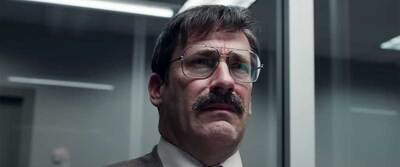
The coldness of corporate America is a much-explored cinematic landscape. The hierarchical dynamics within business spaces lend plenty of opportunity for satirical examination. Whether it’s a horror spin (“Mayhem,” “The Belko Experiment”) or flat-out comedies (“The Office” “Horrible Bosses”), social climbing and capitalist Darwinism are ripe themes for the picking. Joachim Back’s feature debut, “Corner Office,” based on Jonas Karlsson’s novel The Room, is a stab at a Kafka-esque addition to the canon.
Orson (Jon Hamm) is the newest employee at the cheekily-named The Authority. He’s a typical benumbed office cog with a muted brown suit and flat disposition to boot. Working in the offices of The Authority, he encounters gossipy, unfriendly coworkers and a droning boss. He doesn’t mind if he sticks to his schedule and completes his tasks. His cyclical respite, manifested in scheduled breaks during the day, involves leaving the communal cubicle area and thinking in the corner office he discovers across from the elevator.
In contrast to the white, fluorescent, geometric design of the group’s workspace, the corner office is a mid-century modern dream. The main space is a poster of sterility (down to hospital-blue shoe covers worn by the employees to protect the floor), stunning wood-paneled walls, a large executive desk, and a perfectly curated record collection bathe the corner office in warmth and invitation. Not only does Orson find the room an ideal space to recharge, but he comes to find that he can only excel at his job when working within its walls. However, this habitation creates a hostile work environment once he is confronted by his coworkers about the fact that the room he frequents does not exist.
“Corner Office” nails its intended energy with a dystopian visual tone apparent throughout. With The Authority’s office building being an isolated brutalist high-rise set off a snowed-in parking lot filled with identical cars, it’s clear that the film is built on the feeling of stark neutrality. This coldness is an accessory to that of the script, which largely consists of voiceovers of Orson’s inner dialogue. These voiceovers also serve as the core of the film’s comedic chops.
Orson is marked by his detachment and rigidity, but also his arrogance. Much of this social distance is intentional, as he has no interest in his coworkers, but there is also plenty of evidence to suggest that Orson does not understand people. Hamm delivers his inner dialogue exceptionally, with dry monotony, unempathetic social observations, and notes on the status quo reminiscent of “American Psycho.” However, these voiceovers quickly devolve from being the film’s comedic center to its crutch.
The humor of “Corner Office” quickly grows tired. The structure and delivery are stagnant, dragging the film into restless territory by the time it’s only halfway through. The question of whether the room exists and what the answer means for the characters is what holds our investment, but the runtime becomes tedious while we wait for the reveal.
Back’s filmic thesis is present though not fully realized. The script packs punchlines but eventually fizzles out, the film wavering while trying to balance its promise and lack of substance. “Corner Office” is a sometimes-funny satire stuffed with capitalist ennui, but it bites with dull teeth, failing to provide enough support for its sentiment to stick.
On demand and in limited theatrical release now.

Acclaimed actress/playwright/director Regina Taylor‘s new play, Exhibit, will be staged on Friday, September 8th, and Wednesday, September 13th, as part of “Solo Flights,” an annual week-long developmental festival in Aspen, Colorado, of one-person shows presented in the beginning stages of their making. Taylor wrote and stars in the production, which is directed by Emmy-nominee Phylicia Rashad.
According to its official synopsis, Exhibit is about “an African-American woman, Iris, who recalls pieces of her childhood as she integrated a school in Muskogee Oklahoma. Her personal recollections are flashes of a sharply polarized America in transition as the civil rights movement rolls forward. Iris’s memories of her martyred innocence for a cause are triggered by things she thought she’d never see again in her lifetime- the enactment of today’s roll back of the social tides of change.”
A native of Dallas, Texas, actress Regina Taylor earned praise early in her acting career for portraying Minnijean Brown, a member of the Little Rock Nine, in 1981’s “Crisis at Central High.” She gained the attention of mainstream audiences in 1989’s “Lean on Me,” in which she played an auspicious student’s drug-addicted mother.
For her role as Lilly Harper, the Black housekeeper on the early ’90s TV series, “I’ll Fly Away,” she received a Golden Globe award for Best Actress in a Television Drama—the first African American to do so—and also an NAACP Image Award for Outstanding Actress in a Drama Series. She was also the first African American to play the lead in a “Masterpiece Theatre” production on PBS, the Langston Hughes adaptation, “Cora Unashamed.”
Onstage, Taylor became the first Black woman to play Juliet in Romeo and Juliet on Broadway. She is also an accomplished playwright, serving as a writer-in-residence at the Signature Theatre and a Distinguished Artistic Associate of Chicago’s Goodman Theatre. She won a best new play award from the American Critics’ Association for her play about 1940s female jazz musicians, Oo-Bla-Dee, and earned four Helen Hayes Awards, including those for Best Direction and Best Regional Musical, for Crowns, a “play-with-gospel-music” based on the book of the same name of photographs by Michael Cunningham and journalist Craig Marberry.
At the 2012 Chicago International Film Festival, Taylor interviewed Viola Davis, who was that year’s recipient of a Career Achievement Award at the festival’s Black Perspectives Tribute. She went on to portray Davis’ mother in the miniseries, “The First Lady,” in which the Oscar-winner portrayed Michelle Obama. Taylor recently received a Best Guest Actress in a Drama Series nomination from the Hollywood Critics Association for her guest appearance on “CSI: Vegas,” and hosted an acting studio master class this past May.
For more info on Regina Taylor, visit her official site. You can find more information on Solo Flights and the full line-up of performances here.
Matt writes: Few people have made me laugh to the point of hyperventilating as much as Paul Reubens (a.k.a. Pee-wee Herman), who died on July 30th at age 70, following a private six-year battle with cancer. The freewheeling imagination and exuberance of “Pee-Wee’s Playhouse” left a lasting impression on my sister and me, as did his comic masterpiece, “Pee-Wee’s Big Adventure,” Tim Burton’s 1985 debut feature that served as an inspiration for Greta Gerwig’s “Barbie.”
Throughout my childhood, I collected nearly all of the “Playhouse” dolls, and have made the show’s star-studded 1988 Christmas special a holiday perennial. Reubens also made numerous unforgettable appearances in such films as “Batman Returns,” “The Nightmare Before Christmas,” “Matilda” and “Blow,” as well as a gloriously unhinged cameo as Pee-Wee in Frankie and Annette’s you-gotta-see-it-to-disbelieve-it gem, “Back to the Beach.”
“Please accept my apology for not going public with what I’ve been facing for the last six years,” Reubens wrote in a statement to be published posthumously. “I have always felt a huge amount of love and respect from my friends, fans and supporters. I have loved you all so much and enjoyed making art for you.” And our lives have been all the richer for it, Paul.
Read Marya E. Gates’ beautiful tribute to Reubens here, and enjoy the iconic “Tequila” scene from “Pee-Wee’s Big Adventure” in the video embedded below…
Golda (2023). Directed by Guy Nattiv. Written by Nicholas Martin. Starring Helen Mirren, Zed Josef, Claudette Williams. Synopsis: Focuses on the intensely dramatic and high-stakes responsibilities and decisions that Golda Meir, also known as the ‘Iron Lady of Israel’ faced during the Yom Kippur War. Debuts in the US on August 25th, 2023.
Dicks: The Musical (2023). Directed by Larry Charles. Written by Aaron Jackson and Josh Sharp. Starring Megan Mullally, Nathan Lane, Megan Thee Stallion. Synopsis: A pair of business rivals discover that they’re identical twins and decide to swap places in an attempt to trick their divorced parents to get back together. US release date is TBA.
Coup De Chance (2023). Written and directed by Woody Allen. Starring Lou de Laâge, Valérie Lemercier, Melvil Poupaud. Synopsis: Two young people’s bond leads to marital infidelity and ultimately crime. Debuts in the US on September 27th, 2023.
Circus Maximus (2023). Directed by Travis Scott, Kahlil Joseph, Valdimar Jóhannsson, Harmony Korine, Gaspar Noé and Nicolas Winding Refn. Written by Travis Scott. Starring Travis Scott, Rick Rubin, James Blake. Synopsis: A surreal and psychedelic journey, uniting a collective of visionary filmmakers from around the world in a kaleidoscopic exploration of human experience and the power of soundscapes. US release date is TBA.
The Good Mother (2023). Directed by Miles Joris-Peyrafitte. Written by Miles Joris-Peyrafitte and Madison Harrison. Starring Hilary Swank, Olivia Cooke, Jack Reynor. Synopsis: A journalist who, after the murder of her estranged son, forms an unlikely alliance with his pregnant girlfriend to track down those responsible for his death. Together, they confront a world of drugs and corruption. Debuts in the US on September 1st, 2023.
Bad Things (2023). Written and directed by Stewart Thorndike. Starring Gayle Rankin, Hari Nef, Molly Ringwald. Synopsis: A group of friends go to a hotel for a weekend getaway and soon discover that women do bad things here. Debuts on Shudder on August 18th, 2023.
The Kill Room (2023). Directed by Nicol Paone. Written by Jonathan Jacobson. Starring Uma Thurman, Samuel L. Jackson, Maya Hawke. Synopsis: A hitman, his boss, an art dealer and a money-laundering scheme that accidentally turns the assassin into an overnight avant-garde sensation, one that forces her to play the art world against the underworld. Debuts in the US on September 29th, 2023.
Disenchantment (2023), Final Season. Created by Matt Groening and Josh Weinstein. Starring Abbi Jacobson, Eric André, Nat Faxon. Synopsis: Princess Tiabeanie, ‘Bean’, is annoyed at her imminent arranged marriage to Prince Merkimer. Then she meets Luci, a demon, and Elfo, an elf, and things get rather exciting, and dangerous. Debuts on Netflix on September 1st, 2023.
The Morning Show (2023), Season Three. Created by Jay Carson and Kerry Ehrin. Starring Jennifer Aniston, Reese Witherspoon, Billy Crudup. Synopsis: An inside look at the lives of the people who help America wake up in the morning, exploring the unique challenges faced by the team. Debuts on Apple TV on September 13th, 2023.
Only Murders in the Building (2023), Season Three. Created by John Hoffman and Steve Martin. Starring Steve Martin, Martin Short, Selena Gomez. Synopsis: Three strangers – who live in the same New York City apartment building and share an obsession with true crime – suddenly find themselves embroiled in a murder. Debuts today on Hulu.
Heartstopper (2023), Season Two. Created by Alice Oseman. Starring Joe Locke, Kit Connor, William Gao. Synopsis: Teens Charlie and Nick discover their unlikely friendship might be something more as they navigate school and young love in this coming-of-age series. Now streaming on Netflix.
Strange Planet (2023). Created by Dan Harmon. Starring James Adomian, Cedric Yarbrough, Hannah Einbinder. Synopsis: Based on Nathan Pyle’s webcomic Strange Planet. Debuts on Apple TV on August 9th, 2023.
I Am Groot (2023), Season Two. Created by Kirsten Lepore. Starring Vin Diesel, Bradley Cooper, Fred Tatasciore. Synopsis: A series of shorts featuring the seedling Groot along with several new and unusual characters. Debuts in the US on September 6th, 2023.
The Palace (2023). Directed by Roman Polanski. Written by Roman Polanski, Ewa Piaskowska and erzy Skolimowski. Starring Oliver Masucci, Fanny Ardant, John Cleese. Synopsis: A drama set on New Year’s Eve 1999 in a luxurious Swiss hotel where the lives of hotel workers and various guests get intertwined. Debuts in the US on September 28th, 2023.
Depp v. Heard (2023). Directed by Emma Cooper. Starring Orlando Bloom, David Harbour, Djimon Hounsou. Synopsis: Showing both testimonies side-by-side for the first time, this series explores the trial that set Hollywood ablaze and the online fallout that ensued. Debuts on Netflix on August 16th, 2023.
Strays (2023). Directed by Josh Greenbaum. Written by Dan Perrault. Starring Will Ferrell, Jamie Foxx, Sofía Vergara. Synopsis: An abandoned dog teams up with other strays to get revenge on his former owner. Debuts in the US on August 18th, 2023.
Saw X (2023). Directed by Kevin Greutert. Written by Josh Stolberg and Pete Goldfinger. Starring Tobin Bell, Shawnee Smith, Steven Brand. Synopsis: Chasing a promising procedure that would allegedly cure his cancer, John Kramer heads towards Mexico to go through an experimental treatment, only to find out he was prey for a scam. Now, the scammers becomes the prey on Jigsaw’s new game. Debuts in the US on September 29th, 2023.
The Exorcist: Believer (2023). Directed by David Gordon Green. Written by David Gordon Green and Peter Sattler (based on characters created by William Peter Blatty). Starring Ellen Burstyn, Ann Dowd, Leslie Odom Jr. Synopsis: Sequel to the 1973 film about a 12-year-old girl who is possessed by a mysterious demonic entity, forcing her mother to seek the help of two priests to save her. Debuts in the US on October 13th, 2023.
Matt writes: Director Morissa Maltz and actor Lily Gladstone recently spoke with Marya E. Gates about their new film, “The Unknown Country,” which was praised by Sheila O’Malley. You can read their full conversation here.
Matt writes: I had the great pleasure of covering the 2023 Indy Shorts International Film Festival, which included many Oscar-worthy shorts including Alden Ehrenreich’s prize-winning directorial debut, “Shadow Brother Sunday.” You can read my full coverage here.
The Private Life of Henry VIII (1933). Directed by Alexander Korda. Written by Arthur Wimperis and Lajos Biró. Starring Charles Laughton, Robert Donat, Franklin Dyall. Synopsis: King Henry VIII marries five more times after his divorce from his first wife Catherine of Aragon.
Loves of Three Queens (1954). Directed by Marc Allégret and Edgar G. Ulmer. Written by Æneas MacKenzie, Roger Vadim and Salka Viertel. Starring Hedy Lamarr, Massimo Serato, Alba Arnova. Synopsis: At a wedding party involving three beautiful women, a young man should choose the most charming. But a professor intervenes to prevent the verdict, remembering the troubles caused by Paris in a similar situation.
The Smallest Show on Earth (1957). Directed by Basil Dearden. Written by William Rose and John Eldridge. Starring Virginia McKenna, Margaret Rutherford, Peter Sellers. Synopsis: A young couple inherits a debt-ridden old movie theater, appropriately nicknamed “The Flea Pit”, and the three eccentric senior citizens who work there.

I was so sad to hear of the death of celebrated filmmaker William “Billy” Friedkin, a director who made one of my favorite films of all time, and who was much admired by my late husband, Roger. I send the deepest condolences to his wife, Sherry Lansing, and their family. I knew both Billy and Sherry as lovely, decent people who, in addition to their talent in the film world, were also philanthropic and reached out to lend a hand in various charitable endeavors.
Personally, I am so grateful to Billy (and Sherry) for being so helpful when Roger was sick, helping to lift Roger’s spirits when he was in the hospital. And helping to lift mine after his death. Even though they both went on to make names for themselves in Hollywood, they both retained those kind Midwestern (Chicago) values. He died yesterday, August 7th, at the age of 87.
I am on the board of the LA Opera, and the President and CEO, Christopher Koelsch, notified us of the quite extensive opera background of Friedkin’s that I was not aware of. “Billy had a profound impact on the LAO community with his extraordinarily insightful and extremely popular productions of Bluebeard’s Castle/Gianni Schicchi (2002), Ariadne auf Naxos (2004) and Il Tabarro/Suor Angelica (2008),” he wrote. “He also won acclaim for productions around the world, including Wozzeck, The Makropoulos Case and Rigoletto in Florence, Salome in Munich, and Aida in Turin.”

Billy’s talents extended far and wide, even saving someone from death row. Interestingly, he told Donald Liebenson, one of our Contributors at Rogerebert.com, that when he made his first film, 1962’s “The People vs. Paul Crump,” “I had the hope, but not the certainty, that it would help Crump in some way and that it would in some way be the beginning of an education for me in how to make a film.” But his actions led to Paul Crump being taken off of death row.
Roger saw the potential in Friedkin’s work early on, praising his 1968 film, “The Night They Raided Minsky's,” writing, “It avoids the phony glamour and romanticism that the movies usually use to smother burlesque (as in ‘Gypsy’) and it really seems to understand this most-American art form.” Roger also favored Friedkin’s 1969 adaptation of Harold Pinter’s “The Birthday Party,” claiming that “it’s impossible to imagine a better film of Pinter’s play than this sensitive, disturbing version.”
Yet it was in 1971’s “The French Connection” where Friedkin’s genius was on full display, particularly in its landmark car chase sequence. “In Friedkin’s chase, the cop has to weave through city traffic at 70 m.p.h. to keep up with a train that has a clear track: The odds are off-balance,” marveled Roger in his four-star review. “And when the train’s motorman dies and the train is without a driver, the chase gets even spookier: A man is matched against a machine that cannot understand risk or fear. This makes the chase psychologically more scary, in addition to everything it has going for it visually.” The film went on to win five Oscars including Best Picture and Best Director.

Friedkin’s next picture, 1973’s “The Exorcist,” is on my Top Ten List of Movies. It is also the one for which he is most widely remembered, in part because it continues to frighten audiences a half-century after its release. “If movies are, among other things, opportunities for escapism, then ‘The Exorcist’ is one of the most powerful ever made,” Roger wrote in his four-star review. “Our objections, our questions, occur in an intellectual context after the movie has ended. During the movie there are no reservations, but only experiences. We feel shock, horror, nausea, fear, and some small measure of dogged hope.” In 1979’s “The Brink's Job,” Roger wrote in his three-star review that Friedkin affirmed his versatility by exhibiting “a light touch, an ability to orchestrate rich human humor with a bunch of characters who look like they were born to stand in a police lineup.”
Roger said that Friedkin crafted another of the all-time great chase sequences in 1985’s “To Live and Die in L.A.” “I don’t know how Friedkin choreographed this scene, and I don’t want to know,” Roger wrote in his four-star review. “It probably took a lot of money and a lot of drivers. All I know is that there are high-angle shots of the chase during which you can look a long way ahead and see hundreds of cars across four lanes, all heading for the escape car, which is aimed at them, full speed. It is an amazing sequence.
1992’s “Rampage” offered a different angle on the death penalty debate, as detailed in Roger’s three-star review: “Friedkin does not quite say so in as many words, but his message is clear: Those who commit heinous crimes should pay for them, sane or insane.” 1994’s “Blue Chips” also received thumbs up from Roger, who wrote, “What Friedkin brings to the story is a tone that feels completely accurate; the movie is a morality play, told in the realistic, sometimes cynical terms of modern high-pressure college sports.”

For 2003’s “The Hunted,” Roger found that the director had stretched his mastery of the chase sequence to feature-length. “Here the whole movie is a chase, sometimes at a crawl, as when Hallam drives a stolen car directly into a traffic jam,” he wrote in his three-and-a-half star review. “What makes the movie fresh is that it doesn’t stand back and regard its pursuit as an exercise, but stays very close to the characters and focuses on the actual physical reality of their experience”
Roger awarded another three and a half stars to Friedkin’s 2007 adaptation of Tracy Letts’ hit play, “Bug,” which he hailed as “a claustrophobic masterpiece” and a “return to form” for the director. The final Friedkin film reviewed by Roger was another Letts adaptation, 2012’s “Killer Joe,” which he praised in his three-star review as “one hell of a movie. It left me speechless. I can’t say I loved it. I can’t say I hated it. It is expertly directed, flawlessly cast and written with merciless black humor.”
After Roger passed away in 2013, Billy Friedkin paid tribute to him at the inaugural Chicago Critics Film Festival by quoting a verse from Dylan Thomas’ poem, “And Death Shall Have No Dominion,” which I am now quoting today in the director’s honor… Billy, I hope you Rest in Bliss.
“And death shall have no dominion.
Dead men, naked, they shall be one
With the man in the wind, and the west moon;
Though they go mad
They shall be sane,
Though they sink through the sea
They shall rise again;
Though lovers be lost
Love shall not;
And death shall have no dominion.”
Read Scout Tafoya’s tribute to William Friedkin here.

Season Three of “Only Murders in the Building” takes the Hulu series co-created by John Hoffman and Steve Martin to the venue it was practically built for: the theater. For a comedy-mystery series that has long flourished with jokes about art imitating life’s absurdities, “Only Murders in the Building” now has some razzle-dazzle from musical numbers by Benj Pasek and Justin Paul (“La La Land“), special guest performances from Meryl Streep and Paul Rudd, and a Broadway stage haunted with superstition.
But this season is also the most serious one yet: when it’s not teasing out some musical comedy, or packing in some fun surprises to its murder mystery, “Only Murders in the Building” faces the growing loneliness of our three favorite Arconia residents, Charles (Steve Martin), Mabel (Selena Gomez), and Oliver (Martin Short). Yes, they have podcast fame, and Oliver and Charles have minor celebrity days they can look back to. But after all this business with death, they want to feel seen, and loved, too. And as Oliver’s story deepens, “Only Murders in the Building” makes overtures about legacy and what people will remember you by long after you’ve moved out. Will you even make it to their off-hand anecdotes?
The first two episodes are a strong start, kicking off with its star power of new additions Rudd and Streep. As Arnoniacs may remember from last season, Rudd was seen at the end of episode ten sharing bitter words with co-star Charles-Haden Savage before a curtain goes up on “Death Rattle,” the Broadway production directed by Oliver Putnam. (The play is about a baby accused of murder, naturally.) And then Rudd’s character Ben Glenroy collapses on stage without a pulse.
“Only Murders in the Building” does get a juicy murder for its season, but that isn’t it—it’s quickly revealed at the play’s Opening Night party (what, you thought Oliver would cancel it?) that Ben is alive. He storms back into the party and addresses his fellow cast members, including social media influencer Kimber (Ashley Park), the handsome co-lead Ty (Gerald Caesar), his understudy Jonathan (Jason Veasey), the play’s nanny Loretta (Meryl Streep), and Charles. Ben really doesn’t like Charles.

Ben is truly (finally?) murdered not long after, in the Arconia, with a laugh-out-loud reaction from one of the apartment’s most expressive residents, Uma (Jackie Hoffman). But while the trio starts their investigation, this season is most of all about the heart—and heart rate—of Oliver. After getting a pan in-person from a critic (who tells him his mystery “just doesn’t sing”), the scarf-wearing theatrical titan has a heart attack. He then gets a heart-monitoring device, and advice that he needs to not stress. But the show must go on, so he reimagines “Death Rattle” as a tried-and-true musical, now with triplets. He falls for Loretta in the process, and “Only Murders in the Building” gets its true show-stopping moments when Short and Streep are flirting. Short successfully breaks Oliver’s character from his known sassiness in these moments and reveals a deep sensitivity.
Meanwhile, there’s always Charles, with his love of omelet-making and his kitchen art that says “NICE, HOT VEGETABLES.” Charles, still played with such graceful self-deprecation by Martin, once again finds himself in a relationship in which his happiness is uncertain. It feels like a repeated emotional note, but Martin doesn’t hollow out the character. And as this series nudges with a comical motif about a blank white room—with a smiling Martin dressed in the color, an ebullient smile on his face—maybe he likes being solo.
Mabel remains the story’s greatest emotional enigma, with a sudden but forgotten reveal that her time in the Arconia is winding down (her aunt is selling the lavish place she’s been staying in). She’s the most hypervigilant of the three, even when she starts to hang with a documentarian named Tobert (Jesse Williams). Gomez is still compelling in a role that doesn’t wrestle with ego, but her comfort with other people. The legacy of Bloody Mabel from Season Two haunts “Only Murders in the Building,” as that was the last time this show made more of an effort to make Gomez’s talents central to the story.

This season’s writing is sound in a way that shouldn’t surprise anyone. Of course, it is; that’s how the show has been designed with its playful misdirections of motive and shocking moments quickly turned into a joke. “Only Murders in the Building” has a standard for writing and cleverness that’s simply higher than so many other productions. And the production design continues to be top-notch, with apartments that capture the soul of their inhabitants, like Oliver’s makeshift gaudy theater of a living room or the cramped square that Loretta lives in, her bed folding out from a wall.
Such a reliably amusing season is then spiked with ideas about theaters and ghosts, both emotional and possibly literal. There could be more commitment to the series’ flights of musical fancy (as with a random Fosse-inspired number), but it’s at least in the air.
It’s perhaps revealing of this season’s problems that it can’t get many great jokes out of casting Paul Rudd in such a role. Yes, Rudd is charming as a disarming star who can make numerous jokes about how he’s endearing even when he’s possibly the worst person in the room. But that Rudd is a perfect choice for Ben Glenroy is more about the joke that has been made plenty of times before about how lovable he is—including a 2016 Bud Light commercial with the punchline “Everybody Loves Paul Rudd.” Even though Rudd’s obnoxiousness made me laugh a few times (boasting about his big movie franchise, “CoBro”), “Only Murders in the Building” raises the same nagging question when hearing him voice a gecko-bro in the recent “Teenage Mutant Ninja Turtles: Mutant Mayhem”: Rudd’s face may not age (there are jokes here about that too) but maybe his persona shtick has expired?
There’s more rewarding fun to be found in the presence of Meryl Streep. Her struggling, lonely actor Loretta appears in select episodes, sometimes channeling her immediate Streep prowess (switching overwrought accents during a read-through) or playing against it, like when she shivers with uncertainty when it’s her time in the spotlight. There is a meaningful wink in her casting, of seeing the legendary Streep as an avatar for all those who wanted to follow in her footsteps. But Streep is here to be more than a glorified cameo, and some of the show’s most impactful moments come from her innate on-screen magic.
There are just certain parts of the entertainment experience missing in Season Three, which is strange to say given how much fun its wacky musical numbers can be. Mostly by its own design, it’s just not as funny, and it’s not heartbreaking as its reflection-heavy mood wants to be. As Oliver and Charles well know, not every passion project can be a hit.
Eight episodes of Season Three were screened for review. The first two episodes of Season Three of “Only Murders in the Building” are now playing on Hulu, with a new episode each week.

Stanley Kubrick’s “The Shining” is utterly eerie for its baroque uncertainty. As its three main characters are hopelessly isolated inside its vast and ominous setting, the movie constantly unnerves us with the increasing unreliability of their respective viewpoints. The result is alternatively baffling and terrifying to the very end.
Noticing again how cold and distant the movie is to the madness of its main characters, I could not help but think of the last act of Kubrick’s “2001: A Space Odyssey.” The astronaut hero finds himself marooned inside a coldly decorated room after his fantastic journey across space and time, and his following transformation in that room looks like he is being observed by something beyond his (and our) perception. In the case of “The Shining,” its three main characters are stuck inside a big hotel in some remote mountainous area of Colorado. Sometimes they feel like test subjects ready to be manipulated by whatever is hovering over the hotel.
From the opening scene, Kubrick does not hide his intention. Shrouded in insidiousness from the synthesizer performance of “Dies Irae” on the soundtrack, this spooky opening scene steadily looks over a small car driving toward the hotel. It is followed by a banal meeting between a hotel manager and Jack Torrance (Jack Nicholson), who happens to be hired as the hotel’s caretaker during its upcoming closing period. The hotel manager tentatively warns Jack that the hotel can be completely shut off from the outside world during snowy winter days, and he even mentions a terrible incident involving a former caretaker of the hotel. Jack assures the hotel manager that he and his family will be all right: “And as far as my wife is concerned, I’m sure she’ll be absolutely fascinated when l tell her. She’s a confirmed ghost story and horror film addict.”
Meanwhile, we also learn about Jack’s wife, Wendy (Shelley Duvall), and their young son Danny (Danny Lloyd). Danny happens to have a sort of psychic power, and his imaginary friend shows him a series of disturbing moments implying what may happen in the hotel. During her following conversation with a doctor who checks on Danny, Wendy casually reveals Jack’s alcoholism and how this serious human flaw of his led to a traumatic incident for both her and Danny some time ago.
Once Jack and his family enter the Overlook, the movie frequently emphasizes how big and wide the hotel looks inside—especially when they are the only people inside the hotel after its closing day. As the camera steadily follows its main characters moving around here and there in the hotel, their surrounding environment often feels as vast as the space background of “2001: A Space Odyssey.” There seems to be no possible way out for them at times, as reflected when the camera ominously looks down upon Wendy and Danny wandering inside a big hedge maze right next to the hotel building.
Around that point, Jack is already tumbling toward madness, so we depend more on Danny and Wendy’s perspective. Still, neither is very reliable because they become psychologically isolated in their own way too. After experiencing something scary in a certain room in the hotel, Danny’s mind is much more unsettled than before, and those horrific visions of his soon come quite true to his petrified horror. In the case of Wendy, she desperately tries to get things under her meager control, but there inevitably comes a point where she finds herself swept into her terror and confusion.
Kubrick keeps everything cold and distant, just like he did in many of his films, which makes the movie all the more terrifying. While its three main characters are broad caricatures, their descent into insanity is still quite arresting because of the overwhelming claustrophobia. Seemingly trapped forever in their separated status, they lose more human qualities alone, which was probably why Kubrick deliberately had his two lead performers go over the top in their forthright acting. While Nicholson dials up his familiar manic mode as much as demanded, Shelley Duvall amplifies her neurotic quality to the extreme. Her strenuous efforts here in this film deserve more appreciation, especially considering how Kubrick harshly treated her during the shooting.
In the meantime, we are also baffled by the ambiguity surrounding the main characters’ feverishly warped viewpoints. Are there actually some supernatural entities in the hotel? Or are Jack and his family merely experiencing hallucinations fueled by Danny’s psychic power? A key scene later in the story, which unfolds inside a storage room, strongly suggests that there are indeed ghosts in the hotel. However, the movie remains ambiguous about their existence to the end, with its very last shot raising more doubts and questions.
The movie provides a bit of an objective viewpoint via Dick Halloran (Scatman Crothers), the hotel chef with the same psychic ability as Danny. During his conversation with Danny early in the film, he indirectly recognizes that there is something not so good inside the hotel, and he later comes to the rescue after receiving a psychic SOS from Danny. However, to put it mildly, the movie does not let him clarify the ongoing situation surrounding Danny and his parents.
I forgot to mention that “The Shining” is based on the novel of the same name by Stephen King, who disliked the movie for understandable reasons. To King’s dismay, Kubrick erased most of the human depth in the original story while adapting with co-writer Diane Johnson. Instead, he distilled the claustrophobic qualities of King’s story for his single-minded artistic vision, and his achievement has considerably influenced a bunch of arthouse horror films, such as Ari Aster’s debut feature “Hereditary” (2017), which owes a lot to “The Shining.”
By the way, King later attempted to distance his novel further from Kubrick’s film by writing its sequel novel “Doctor Sleep.” However, to our little amusement, the following movie adaptation directed by Mike Flanagan was not free from Kubrick’s film, even when it is faithful to King’s sequel novel. That says a lot about the inescapable cinematic power of Kubrick’s film, doesn’t it?