
People brought gifts of all kinds to Kiesha and Emmett’s housewarming party on this week’s The Chi. But there are two, in particular, that I can’t stop thinking about now that the episode is over. The first: Nuck’s apology to Kiesha, which comes three seasons too late. Longtime viewers will recall that, at the start […]
Superman & Lois’ Bitsie Tulloch Reunites With Jordan Elsass (OG Jonathan) on SAG-AFTRA Picket Line
It’s the Kent family reunion we never thought we’d see: Bitsie Tulloch on Friday shared a snapshot of herself on the SAG-AFTRA picket alongside Superman & Lois co-star Wolé Parks. And who’s that next to them? Why, it’s none other than Jordan Elsass, who played Tulloch’s on-screen son Jonathan for the CW drama’s first two […]
A League of Their Own’s Second and Final Season Scrapped at Amazon
A League of Their Own has officially — and unexpectedly — struck out at Prime Video. The streamer has opted to scrap the series’ previously announced second and final season, TVLine has confirmed. Also on Friday, Prime Video reversed its Season 2 renewal of the sci-fi drama The Peripheral, starring Chloë Grace Moretz. An Amazon […]
R.I.P. Clarence Avant, Godfather of Black Entertainment (1931-2023)

The world lost a true legend with the death of Clarence Avant, the “Godfather of Black Entertainment,” who passed away August 13th in Los Angeles at age 92. He worked quietly behind the scenes to help advance the careers of so many who became giants in the worlds of music, sports and politics, with the aim of providing access for talented African-Americans who were sometimes excluded at higher levels. I extend the deepest condolences to his daughter Nicole, his son Alexander, his son-in-law Ted Sarandos, the Co-CEO of Netflix, and his extended family. He was predeceased by his loving wife of 54 years, Jacqueline, who died tragically in their home in December of 2021.

When I say legend, it is within the dictionary definition: one who is famous and well-known for doing extraordinary things in their field. The ironic thing is that people within those fields sometimes said they didn’t know exactly what Clarence Avant did, what his title was, or how he did it, but the results spoke for themselves. I came across him not only in the world of entertainment, but in the world of politics where he raised money for former Presidents Bill Clinton and Barack Obama. He also helped Muhammad Ali, Hank Aaron, Jim Brown and other sports figures. Bill Withers said that he provided the big transition from his life as a professional air craft mechanic to being sought after in the music world.
The record labels that Mr. Avant founded in the 1960s and 70s were responsible for releasing the work of trailblazing artists including Jimmy Jam and Terry Lewis as well as Bill Withers. He also gained a reputation for being a sought-after mentor and consultant to such giants as Irving Azoff, Jheryl Busby, Sean Combs, Snoop Dogg, Kenny “Babyface” Edmonds, Jamie Foxx, David Geffen, Whitney Houston, Reginald Hudlin, Jimmy Iovine, Jay-Z, Quincy Jones, Queen Latifah, Jon Platt, Antonio “L.A.” Reid, Sylvia Rhone, Lionel Richie, Pharrell Williams and many others.
For his extraordinary work in the world of music he was inducted into the Rock and Roll Hall of Fame by Lionel Richie in 2021, and the video they put together to introduce him remains one of my favorites. (See Below.)
He also received a star on the Hollywood Walk of Fame for his contributions.

A statement released by his children, Nicole and Alexander, and son-in-law Ted Sarandos, reads, “Through his revolutionary business leadership, Clarence became affectionately known as ‘the Black Godfather’ in the worlds of music, entertainment, politics, and sports. Clarence leaves behind a loving family and a sea of friends and associates that have changed the world and will continue to change the world for generations to come. The joy of his legacy eases the sorrow of our loss.”
He was born February 25, 1931, in North Carolina. I admired him for staying true to his roots and plain spoken even as he became a quintessential power broker. The extraordinary career of Mr. Avant was chronicled in Reginald Hudlin’s 2019 Netflix documentary, “The Black Godfather”, which included testimonials from many of his distinguished admirers, including former President Barack Obama, who noted, “One of the things that he understands is that there are different kinds of power. There’s the power that needs the spotlight, but there is also the power that comes from being behind the scenes.”
Rest in Heavenly Bliss, Clarence Alexander Avant.
Back on the Strip

“Back on the Strip,” about a young man who wants to become a magician and the middle-aged ex-strippers who train him to be an exotic dancer instead, is a slapped-together indie comedy. It would probably crater completely and become unwatchable were it not for the charisma of its actors, which is boundless, and the lightheartedness of the entire project: it knows that the purpose of this movie is to make people laugh, no matter what it takes, and that the more shameless the joke or sight gag, the bigger the laugh.
The strippers were stars in Las Vegas in the 1990s. They called themselves The Chocolate Chips. Wesley Snipes is the leader, Luther, aka “Mr. Big,” whose career ended when a car accident shattered his leg. J.B. Smoove is Amos, a preacher by day, and righteous. Bill Bellamy is Tyriq, a stay-at-home dad to four daughters he sired with his wife, a female bodybuilder. Faizon Love is Desmond, a garage owner who’s gained 100 pounds since his stripping days. Gary Owen is Xander, a white doctor with a successful breast augmentation clinic who, back in the day, fooled the other Chocolate Chips into thinking he was Black (more on that in a moment). Any of these actors has more charm and comic timing in his pinky toe than most actors have in their whole bodies. The film benefits enormously just putting them all together onscreen and watching as they get the old “band” back together, work through differences that split them up, and bust each other’s chops with the easygoing intimacy of brothers. (Kevin Hart’s name is on the poster, but he only has one scene; it’s a good one.)
Unfortunately, the movie isn’t actually about the Chocolate Chips. It’s about young Merlin (played by Spence Moore II) and his career ambitions and romantic problems. Will he get his dream job and capture the heart of his dream girl? You know the answer, and the movie knows you know the answer. But it still stays focused on Merlin, to the point where “Back on the Strip” turns into a modern equivalent of one of those old Hollywood studio movies that built a project around veteran movie comedians that audiences actually came to the theater to see (such as the Marx Brothers) but subordinated their clowning to a love story between a couple of comparatively bland leads.
When we meet Merlin, he’s a high school senior in Los Angeles who’s madly in love with his best friend and magic assistant Robin (Raigan Harris), one of those cheerful, poised, beautiful, smart ciphers that lovable, ambitious heroes often have in comedies. Merlin wants to go to Las Vegas and hit big as an illusionist, and tells Robin about his goal. Alas, his performance at the high school magic show is ruined by his own mistakes, then by the treachery of one of his rivals, the leader of a group of all-white self-styled gangsta rappers from Beverly Hills, who pulls down Merlin’s pants and underwear onstage. Thus do we learn of Merlin’s true gift: a member so enormous that when we see it tucked into his underwear, it looks like a kielbasa folded in half.
Flash-forward a few years to Merlin after college: he’s working as a birthday party clown with a trio of other clowns and still dreaming of going to Vegas when he runs into Robin again. Unfortunately, Merlin also meets her snotty, condescending boyfriend, who is about to become her fiancé. His name is Blaze (Ryan Alexander Holmes). He claims he’s a comedian, but he’s mainly an “influencer” who spends seemingly every waking moment recording himself and his posse and posting the footage online. Merlin’s supportive single mother, Verna (Tiffany Haddish), who’s also the film’s raunchiest character by far, helps her despondent son make his big move to Vegas by calling up her former employer Rita (Colleen Camp), an old stoner who runs a run-down motel with a burned out neon-sign (the only working letters spell out “VAGINA”), and arranging for Merlin to stay there while he’s auditioning for magic gigs. Of course Verna, a hardcore realist, has a secret agenda: she figures her son will have a better shot at being acclaimed for what’s in his top hat if he showcases the miracle in his trousers.
If you’re reading this and thinking, “I’ve seen this nice-guy-tries-to-steal-nice-girl-away-from-rotten-fiancé configuration a million times—what about the aging strippers played by can’t-miss character actors?” you’re just gonna have to deal with it. The movie is determined to push through the contrivances of keeping Merlin and Robin from realizing their destiny right up to the climax, which romantic comedy fans would see coming from 20 kielbasas away, even if the main couple didn’t discuss one of the most beloved TV variations of it on “A Different World” while watching a rerun of the episode in question.
Directed by Chris Spencer, who co-wrote the film’s screenplay with Eric Daniel, “Back on the Strip” doesn’t trouble itself with anything it isn’t really interested in, such as giving the romantic leads actual personalities rather than writing them as a couple of sweet but borderline-blank ingenues; or, for that matter, making you believe that young Merlin is a good or even competent magician. Verna tells us in her voice-over narration, which is often so forced that it sounds like it was written mainly to solve storytelling problems, that Merlin is a brilliant illusionist who wows audiences. But we never see him do anything more complicated than pull a string of handkerchiefs from his mouth or produce an object from behind another person’s ear.
“Back on the Strip” improves once the Chocolate Chips get together again and start rehearsing and reconnecting, and it becomes excellent during the comparatively brief section where it falls in love with its character actors. The movie gives all of the characters a dedicated subplot plus foolproof bits of recurring comic business that let the movie play to its only great strength: its ability to create enough of an atmosphere of trust that its performers can cut loose and clown in a way that goes beyond sketch comedy riffing and into the realm of the surreal. Amos has supposedly left the “sinful” stripper life behind but bumps, grinds, and dry-humps pews during sermons whenever the spirit takes him. Tyriq’s identity is so tied up in fatherhood that when he does his new routine, he instinctively starts combing women’s hair and folding their wraps in perfect squares small enough to fit into a diaper bag. The other guys are shocked when Xander shows up and is obviously a white man—none of them had a clue in the ’90s—and the fact that the script hand-waves away specific details of how Xander pulled off the magic trick (a more impressive illusion than anything Merlin attempts) makes the contrivance funnier—especially when he’s coming to terms with the racial privilege he’s always denied having.
“Back on the Strip” is qualitatively somewhere between a mid-level “Saturday Night Live” cash-in movie and a ’90s indie comedy where the cast greatly outclasses the screenplay. Its ingredients include a few genuinely excellent comic setpieces and several more that are fitfully amusing, and perhaps another dozen moments that let the older actors show sides of their talent that are more often ignored (most strikingly Love, who shows that he could carry an entire romance on his own, should anyone choose to write a brilliant script tailored to his talents and looks).
It’s worth seeing for its hardworking cast, Snipes especially. He seems to be having a career renaissance recently, and he adds another feather to his cap here, playing a once formidable and suave man who walks with a cane because of a car accident and can’t strip anymore, but still manages to seem like he’s in charge of any room that he enters. The filmmakers often cut to his reactions in ensemble scenes not because Big is always an integral part of what’s happening (sometimes he’s just one of several witnesses), but because Snipes’ acting is so rich. You can almost feel the other characters acquiring depth just because Big is paying attention to them and being affected by whatever they’re going through. Snipes doesn’t coast on audience fondness that’s rooted in earlier eras. He’s creating something new here: a real-seeming man with experience in his voice and an unwritten novel in his eyes. His performance is the film’s best magic trick.
In theaters now.
New Walking Dead Zombie Variant Would Make The Whisperers Impossible Now
The new acid zombie variant revealed in The Walking Dead: Daryl Dixon’s first 10 minutes would make the whisperers existence impossible now.
I Can’t Believe I’m Making This Movie: Josh Greenbaum on Strays

Directing an R-rated studio comedy with a canine cast might prove ruff, but “Strays” director Josh Greenbaum found the right howling humor and heart. The latest flick from the “Barb and Star Go to Vista Del Mar” filmmaker has him painting “Homeward Bound” in raunchy R-rated drool for the now-adult audience who grew up with it and is very proud of it, humps and all.
“Strays” follows Reggie, a happy-go-lucky Border Terrier (voiced by Will Ferrell), who assumes the attempts of his neglectful stoner/porn-addicted owner Doug (Will Forte) to abandon him are a game. After being fed up with Reggie’s persistence, Doug drives Reggie three hours away from home and drops him off in a sketchy street alley. There, Reggie meets Bug (Jamie Foxx), a streetwise short-tempered Boston Terrier, Maggie (Isla Fisher), an Australian Shepherd with a strong sense of smell, and Hunter (Randall Park), a kind-hearted, cone-wearing therapy Great Dane. His new paw pals help Reggie recognize his toxic relationship with Doug. With his newfound friends and confidence, Reggie and his friends journey back to Doug’s place to get the ultimate vengeance: ripping Doug’s junk off.
I spoke with Greenbaum about balancing heart and absurd hilarity with his doggy stars and voice actors, the importance of technical departments from trainers to editors to make this talking dog comedy as sophisticated as the adult audience, and finding the right song to go with its insane finale.
I can only imagine it could be really difficult working with so many dogs on camera. Were there any challenges in achieving wide shots of the four dogs getting into their mayhem on their journey?
Yeah, absolutely. From a directing standpoint, I always want to try to find the most interesting shot. The most interesting master shot. And that often means, oh, well, let’s get all four characters in the scene with interesting blocking and move the camera, all of which is not a friend to working with animals, nor is it always a friend to working with VFX. I would push my team to try to deliver what everybody could. And they over-delivered. It was tough. I storyboarded the film, and we worked together.
You quickly learn where trainers can be, where they can’t be, and how to do this very delicate dance with all the different departments of a film to achieve what you want ’cause, even as simple as you forget that dogs don’t hold eye lines with each other. They don’t look at one another; they look at their trainers. That means every trainer’s gotta be behind the other dog to pull an eye line, and you have to time it with a dialogue on the performance. It’s a whole dance that I sort of forced on myself because I set out with sort of a mission to use real dogs for the bulk of the film. I wanted it to feel as real as possible for an audience and especially an adult audience who is a little bit savvier than making a film like this for children.

Since this is a different type of animal than “Barb and Star” …
Ha. Good. Well done.
I had to do the pun. How did you capture the heartfelt tone as you did with that film, with both the voice actors and the recording studio you did with the dogs on screen?
Well, that’s a huge thing to me. No matter how loud and crazy a comedy can get, in the case of Barb and Star, it’s more in this sort of silly absurdist world and PG-13, which I love. And then, of course, we push the envelope here in the outrageousness, in the R-rated nature of this film. But if it doesn’t have an emotional center and, hopefully, something to say, I have difficulty connecting to it and feeling like I understand who these characters are, where they come from, and how to talk to my actors.
So that’s really what pulled me in from the get-go on this script. Yes, it’s a fun, outrageous R-rated talking dog movie. Still, it’s also a metaphor for being in an unhealthy, toxic relationship and how to deal with that, how to get out of it, and how your friends come and help you through that and help you rediscover your own sense of self-worth. And so, there are all these kinds of richer conversations I love as a filmmaker, trying to create an ecosystem for a film where all of that can coexist, all of the sorts of raunchy outrageousness can also kind of, you can go from one scene like that to a genuine grounded emotional scene. The script had it, and then, working with Jamie Foxx and Will Ferrell and our incredible cast, those guys are really great. Let’s not forget Oscar-winning actors who, when you need it to be honest, when you need it to get to go there, which happens with Bug and Reggie and all these dogs, are there, they’re ready to deliver, and they win that.

What was one of the funniest moments when working with the dogs?
Every day was a weird mix of incredibly difficult and then incredibly funny. Like every moment. I remember at one point, it’s four in the morning, we’re shooting in Atlanta, and we’re waiting for Benny, who plays Bug, to hump a pile of trash––that is correct, that’s part of the film that I made, and I’m very proud of it. But we’re waiting for it, and there’s nothing you can do. You have got around 60 to 100 people on your crew waiting. It’s four in the morning, and all you could hear if you came on our set was one little trainer going, “Humpty, Humpty,” ’cause that happened to be the word she used to train the action. And I remember looking around and being like, “This is crazy. I can’t believe I’m making this movie. I can’t believe we’re all here.” And sure enough, Benny did what he needed to do. We were all dying laughing and moved on to the following setup. But there was a moment like that every day of shooting.
What was the relationship between you and the VFX supervisors like? How did you ensure that all the footage you captured still evoked all these emotions reflected when they’re talking?
It’s a massive part of the job. And there are many steps to it. It starts with my trainers. So, I wouldn’t just go through the script and say, “Hey, I need the dogs to hump a bag of trash, knock a door down or spin in circles like they’re going to bed.” Then I’d go through the script and say, “I’m looking for Reggie to feel guilty at this moment as he’s revealing to his friends that he’s feeling guilty about how he wants to go back to Doug.” And I would really walk through the emotions and learn the tools I had from the trainers because I wanted to start there. But then, of course, if we didn’t get it or I wanted to add on top of that, then my incredible VFX team at MPC would come in, and they could start subtly, which is where I always wanted to start, was very subtle on the eyebrows. Or oftentimes, they might take a tail that was wagging on set and slow it down so it looked a little more menacing or stop it from wagging. So, we could lean on all these different behaviors, and the VFX team would kind of step up and help wherever we needed. But it always started with the trainers on set, and I should mention my editors combing through all the footage to find the right moments when it looked like the dog might have delivered that line. And that’s very difficult, but it takes a keen eye to find those moments.
There’s a particular needle drop in the climax that had me rolling. I wanted to know if that was always in the script, or did you guys go through a cycle of different, perfect breakup songs to throw in?
It was probably one of my favorite moments of making the entire film, to be honest. That was not in the script. Dan Perrault’s brilliant script actually had a song in there. Originally it was Lou Reed’s “Perfect Day,” which is a great choice. I love the song, but it wasn’t quite working for me. And it wasn’t anthemic nor making me cheer. I wanted to elicit a feeling of this cathartic moment that might make an audience laugh and feel emotional but also maybe want to cheer and clap. I was trying to figure out what song to do, what genre, and I went to breakup songs because it finally clicked off like, “Well, this is a form of breakup.” I probably listened to three or 400 songs in the course of a day ’cause then I was like, “Oh, we gotta figure this out.” And then I found the song you’re referring to; we won’t give it away, but it is full of chills in my body. I ran down the hallway to the editor; I was like, “Put this in.” And as soon as we married it to a picture, it was like, “Oh, that’s it!” It can be nothing else. And, of course, fingers crossed, will the artist approve it? Because it’s a unique scene to put your song to. And let’s just say that she did watch the scene. She loved it and approved it, and we got the song. So glad you loved that too. Yeah, it’s one of my favorite moments.
“Strays” is in theaters now.
The Power of Imagination: On the 20th Anniversary of Big Fish

“The truth is, I didn’t see anything of myself in my father, and I don’t think he saw anything of himself in me. We were like strangers who knew each other very well.” – Will Bloom, “Big Fish”
One afternoon, over ten years ago now, a colleague made a remark that betrayed what was likely a personal regret: we should make the most of our parents while they’re still alive.
Upon revisiting “Big Fish,” Tim Burton‘s 2003 fantasy drama now reaching its 20th anniversary, it occurs to me that this sentiment relates in some way to Will Bloom, played by Billy Crudup. The film’s plot centers on the difficult relationship between Will and his father, Edward Bloom (Ewan McGregor and Albert Finney). The tension between father and son is underpinned by the tall tales Edward tells that mythologize his life. To Will, they’re a smokescreen his father’s hiding behind, that has stopped him from ever knowing who his father really is.
The experience of watching “Big Fish” has changed as I have. What struck me on viewings during its theatrical run and a year later was the emphasis on fantastical storytelling over the human story. The plot details were generally lost to time, except for a fragmented series of images. After my third viewing, two decades later, I can now relate to Will in a way I couldn’t before. My self-awareness has broadened through life experiences, and I can reflect on the shared history with my father, whose mortality I’m forced to confront.

For some, but not all, Will is a version of ourselves, only in a dramatized and exaggerated context. Experiencing “Big Fish” when you’re fresh out of adolescence to when you’re an adult and entering that period where one is prone to encountering a mid-life crisis is different. To a young person whose future reaches out ahead of them, the film speaks to the hopes and dreams of what their life could be. To an adult, it’s heavy on nostalgia, and the realization of the difficult relationship sons often have with their fathers, as well as the ups, downs, and twists in any life lived.
The relationships in the film are fully formed, and they belong to their own unique and dreamlike world. Yet, the story’s relatability for some filmgoers will resonate in a way that might feel personal to their own experiences. It’s in constant metamorphosis, offering a space for us to emotionally project ourselves upon, becoming a mirror that reflects our image back to us.
Following Burton’s disappointing remake “Planet of the Apes,” whose only saving grace was Tim Roth’s performance, “Big Fish” felt like redemption in 2003. Also, in the coming years, he would go on to direct some lackluster films, like “Sweeney Todd: The Demon Barber of Fleet Street,” “Alice in Wonderland,” and “Dark Shadows,” which left him susceptible to increasing criticism. Unlike “Big Fish,” which saw him broaden his aesthetic, visually brighter with the dark fantasy tones not being as oppressive or noticeable, the films that followed felt increasingly commercialized and hindered by underwhelming storytelling. The impression began to form that Burton was a filmmaker who had given us his best, and “Big Fish” was maybe his one last hoorah.

On the film’s 20th anniversary, it struck me that it would have been a fitting swan song for the director. It conveyed much of what we came to love about Tim Burton and his ability to intertwine imagination and humanity. His characters made us laugh and evoked pathos, and “Big Fish” celebrates both. Filled with a naïve and indulgent affection for storytelling, and an expression of human emotion, it still feels like the perfect, or at least a fitting full stop to the filmmaker’s career. Burton layered a fairytale-esque quality into many of his films. Even in the darker or tragic tones of his work, he was still able to convey romanticism and innocence in films like “Edward Scissorhands” or “Ed Wood,” and those themes reflect in the mirror of “Big Fish.”
It deserves to be remembered, enjoyed, and appreciated by new generations, and yet the film has seemingly fallen between the cracks–lost to time. Aside from Will and Edward’s story, the relationship between Edward and his wife, Sandra (Jessica Lange), is a strong emotional arc. As we watch Edward’s life fade, Burton and screenwriter John August pull on our heartstrings. They craft a touching portrait of love as these two soulmates are forced to finally part in death. Blessed with sensitivity about love, life, family, death, and our love of stories, “Big Fish” is a timeless film that will continue to resonate with future generations.
In its ability to transcend time, it has had a helping hand from human or societal flaws. Look at how the giant and the witch are introduced as ominous figures, only to reveal that neither Edward nor we should fear them–a scene that challenges our adversarial and xenophobic reality. “Big Fish” appeals to our better angels, advocating tolerance and openness towards those different from us.

“Big Fish” possesses an almost wide-eyed innocent quality and Edward is almost an echo of all of us. He represents our inner child, that part of us that never fully grows up, even as we enter adulthood and are saddled with hefty responsibilities. The pleasure of rewatching “Big Fish” is to revel in this pure escapist fantasy, where stories and imagination are not suffocated by reality. If François Truffaut said he preferred the reflection of life to life itself, Edward Bloom managed to find a coping mechanism for his monotonous reality, reshaping it in his own vision.
Two decades later, we still need films like “Big Fish.” The mix of fantasy, imagination, and reality reminds us of the storyteller within us all. It’s an antidote to our contemporary dystopia, one that’s blighted by toxic misinformation, political lies, and stories that serve narcissistic ambitions at the expense of the underprivileged. Edward’s stories might be a stretch, a reality distortion, but they’re harmless. In this current political and cultural upheaval, perhaps Edward Bloom cannot only find new meaning and continue to endure but offer us hope in a time when we’re desperate for some. Unlike narcissistic politicians who rewrite the truth, Edward, Sandra, and their friends don’t deny it; they recognize it and choose to escape reality. “Big Fish” is a timely film that encourages discussions about the relationship between fact and fiction, truth and fake news, and how the two share a complicated bond that compromises each respectively.
Strays

Full disclosure, right off the top: I knew I was going to be a soft touch on “Strays.”
We’re a longtime Boston Terrier family, and I’ve always wondered what our dogs would sound like if they could talk to us. (Surely, I’m not the only one who entertains such insane ideas.) So the prospect of an R-rated comedy in which Jamie Foxx provides the voice of a street-smart Boston named Bug—who drops copious F-bombs, gets high on mushrooms, and humps discarded couches—was very exciting.
“Strays” is pretty much a one-joke movie, one last romp at the end of summer. But it finds enough ways into that joke within its perfectly pithy running time to remain zippy and enjoyable. The way it upends heartwarming dog adventure movie tropes is often hilariously inspired. And there’s great chemistry within the voice cast, particularly between Foxx and star Will Ferrell, who had the unusual benefit of recording together.
Director Josh Greenbaum has shown a flair for out-there comedy with a sweetness at its core in the delightfully bizarre “Barb and Star Go to Vista Del Mar” (2021). He achieves a similar balance with raunchier material in “Strays.” Besides featuring a ton of profanity, the screenplay from Dan Perrault includes plenty of poop and pee jokes (not all of which are entirely puerile), vigorous humping, and some wilderness mayhem that some may find shocking. But the film also explores the importance of identifying and escaping toxic relationships, achieving a sense of self-worth, and basking in the support of deep and unexpected friendships.
I may have teared up a few times. Like I said at the start, a soft touch. Your mileage may vary on this canine road trip.
“Strays” begins on an upbeat note with narration from Ferrell as Reggie, an adorably scruffy Border terrier who’s clueless to the fact that his miserable, abusive owner (Will Forte) hates him and keeps trying to abandon him. “Today is going to be the best day ever!” he intones in a sunny manner reminiscent of Margot Robbie’s optimism at the start of “Barbie.” And totally coincidentally, “Strays” shares a similar structure to Greta Gerwig’s mega-blockbuster: Idealistic character leaves home, goes to the “real world,” makes friends, and learns hard truths before returning to fix things with the newfound knowledge. Only in this case, the protagonist’s purpose is literally to bite off his owner’s penis, a more violent form of eviscerating the patriarchy than Barbie ever could imagine. Ferrell is essentially doing a version of his character in “Elf” here, mixing wide-eyed enthusiasm with deadpan observations and bringing his signature sincerity to a silly role. As always, he’s a hoot.
After his owner dumps him in a faraway city, Reggie gets help in his quest from the trash-talking Bug, who insists he wants to be a stray and navigates the world with the swagger of a little dog who thinks he’s big. Foxx has fantastic energy here, savoring the musicality of his character’s every profane tirade. Along for the trip are the Australian shepherd Maggie (Isla Fisher), a gifted sniffer, and a Great Dane named Hunter (Randall Park), a former police K-9 who now works as a therapy dog for the elderly.
Cursing and calamitous antics ensue, much of which you’ve probably already seen in the trailer, but thankfully there are plenty of surprises in store. The visual effects work is mostly seamless, with all of the dogs (and their unseen trainers) giving impressive physical performances. Some of the CGI in the face and mouth movements are distractingly jumpy and inconsistent, especially regarding Bug’s dialogue. Is it too much to ask for total realism in a late-summer talking dog movie?
The gross-out gags may grow a bit repetitive, but “Strays” ultimately redeems itself by ending on a note that’s feel-good without being cloying. It features some amusing insights into how dogs perceive the world, from fireworks to postal workers. And it just might make you think twice about what that pampered Pomeranian in the expensive sweater is barking about at the dog park.
Now playing in theaters.
birth/rebirth
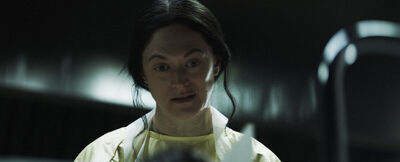
Bodies are messy. Women’s bodies are especially messy. There are so many phases, and so much can go wrong! There are so many procedures required to make things run smoothly, and these procedures are sometimes painful, placing women at the mercy of medical professionals who treat women’s pain with cavalier indifference. (This pain gap has generated a lot of chatter recently.) The pain and stress of having a body subject to the whims of natural (or unnatural) forces is the subject of Laura Moss’ riveting “birth/rebirth,” where two women merge into a joint Dr. Frankenstein as they attempt to re-animate the body of a dead child.
“birth/rebirth” has some “body horror” tropes and some straight horror tropes, but it’s not really a monster story. It’s more of a medical thriller, helmed by two twisted conspirators, both operating from a place of desperation and trauma. The tone Moss establishes makes the events seem almost plausible. What if human bodies could regenerate themselves like a starfish does? Is there any way a dead body could come back to life through legitimate medical means?
The two main characters—Rose (Marin Ireland) and Celie (Judy Reyes)—are well-prepared to address this question. Rose works in a hospital morgue, and Celie is a labor/delivery nurse. To call Rose intense is an understatement: she is forbiddingly anti-social and clearly keeping secrets. On the other hand, Celie is raising her daughter Lila (A.J. Lister) on her own and is well-loved by her colleagues. She clearly loves her job. The two women work in the same hospital but don’t know each other. When Lila dies unexpectedly from bacterial meningitis, Rose—who has already been performing regeneration experiments in her apartment and has successfully brought a dead pig named Muriel back to life—sees her chance for the ultimate experiment. Rose packs the corpse in a suitcase and brings it back to her mad scientist’s lair. When Celie discovers Lila’s body has been “lost,” she suspects Rose and follows her home.
One of the main strengths of “birth/rebirth” is Moss’ resistance to the expected. One might expect Celie to be outraged at what Rose has done. One might expect the film to unfold as a battle of wills: Rose fighting to keep her experiment going and Celie attempting to thwart it and rescue Lila for a proper burial. One might expect Lila to “re-animate” as a monster, turning on her saviors with murderous violence. But … none of that happens.
Instead, we get the absurd spectacle of Celie and Rose, medical professionals, teaming up to work on the experiment. Celie moves in with Rose. They take shifts watching over the dead child. They rush out the door to their real jobs. They pack lunches in the kitchen. Muriel, the regenerated pig, snuffles in the corner, and Lila lies in bed, her skin a purplish hue. Since fetus cells are needed to make the essential serum, Celie uses her position at the hospital to acquire it through dishonest—and, frankly, monstrous—means. Even more terrible is the glimpse of how Rose got those fetus cells before Celie, the maternity nurse, came along. It involves unwitting men, bar bathrooms, globs of collected sperm, and syringes. It’s gruesome, but not half as gruesome as how Rose handles her eventual pregnancies. Much of this is stomach-churning, but the subversiveness of “birth/rebirth” is that almost everything shown is an everyday medical procedure, procedures women endure every day in the normal world. The physical demands of having a body, of getting pregnant, bringing a pregnancy to term, of labor, delivery, infertility, damaged cervixes, and all the rest … are here, but twisted. These women will stop at nothing. It’s a match made in mad-scientist heaven.
Both actresses deliver layered and complex performances. The film is often funny, one of the many ways Moss allows for the unexpected. The humor comes from the juxtaposition of what Rose and Celie are trying to do with how matter of fact they are doing it. The dead child lies in bed as the women make lunches, or feed the omnipresent Muriel, or problem-solve each crisis. They make cracks about one another’s diet like a bickering married couple. “At least you didn’t do anything unethical like eat a ham sandwich,” snaps Celie at one point. Celie is all warm and caring; Rose is cold and calculated. Together they make a formidable team. They will use anyone and anything to achieve their goals. In this, they betray the women in their care—dead and alive. Natural biological processes are often very stressful. Nobody knows this better than Celie: she knows the buttons to push with a nervous pregnant woman, and she does.
It’s amazing how far “birth/rebirth” goes into this amoral territory. Lila’s regeneration is a “miracle,” although Rose balks at the term when Celie uses it. This is science, nothing more. The mood established is eerie and mournful, the colors muted and hospital-morgue-green. There are barely any scenes outdoors. Nature doesn’t exist in this world. Ariel Marx’s score is well-placed, sometimes taking on a light tone, adding to the destabilized atmosphere—the music drones on subliminally in an eerie counterpoint. There are a couple of false notes along the way, where Lila’s regeneration seems to be going off the rails, where the supernatural appears to be raising its dead-eyed head. These scenes come from another movie running on “expected” lines.
Two small moments, neither of which center on Celie or Rose, stand out as pointed reminders of the resonances at play in this creepy tale. Early on, Celie assists with a birth. The woman is working hard; the husband stands by supportively. Suddenly the doctor says, “I’m going to perform an episiotomy,” and the woman gasps, “Oh, please, let me try to do it myself!” In her plea is every story you hear about women’s choices being ignored, their concerns about their own bodies dismissed and overruled. In the second moment, a pregnant woman is in crisis on the delivery table, enduring the chaos of an emergency C-section. The nurse reassures her, “Your baby’s going to be fine, I promise you.” Good news! The pregnant woman asks foggily, “What about me?” She’s terrified. The nurse barely understands the question. What about you? What kind of question is that for a pregnant woman to ask? Who cares about you?
Now playing on Shudder.